The Distance Businesses Can Change
Reflections on human capital, business friction, geography, infrastructure and trust
I recently read M.G. Quibria’s Daily Star article, “Bangladesh’s FDI puzzle: Why human capital, not red tape, is the real constraint.”
What interested me most was not the FDI question itself. It was the distinction between problems that can be addressed relatively quickly and deeper structural constraints that cannot.
Quibria argues that the business environment matters, but human capital imposes a more fundamental constraint. He also makes a less commonly discussed point: geography matters not simply because of proximity to markets, but because of proximity to capital, industrial knowledge, and established supply chains.
That made me think about the same issues from the perspective of a company operating within those constraints.
A business cannot choose its country’s geography. It cannot reform the education system, redesign the banking system, improve a port or eliminate every administrative complication.
But neither is it simply a prisoner of its environment.
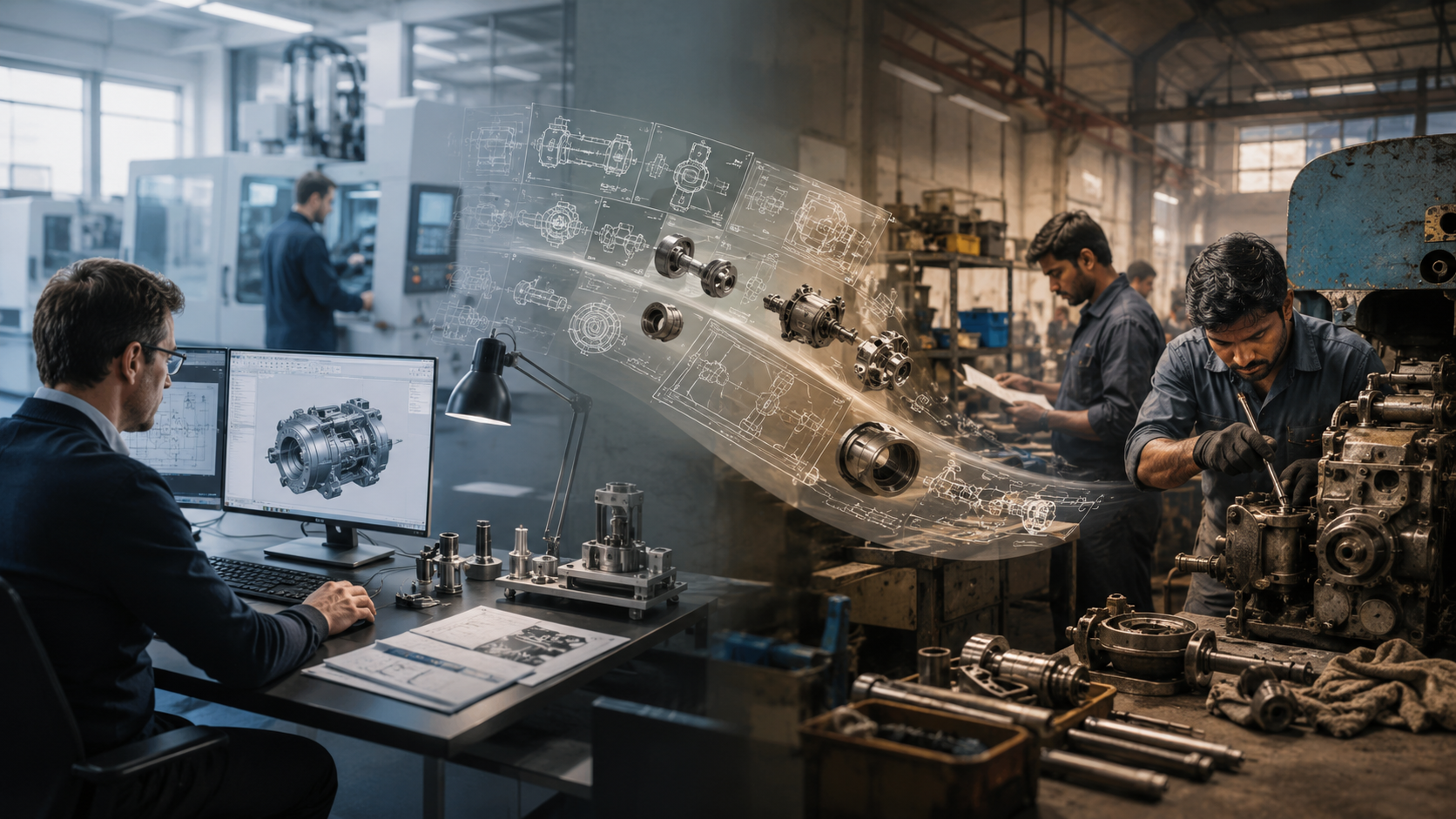
After many years working with European industrial manufacturers in Bangladesh, I have come to think of the challenge in terms of distance.
There is a distance between qualifications and actual capability. Between initiating a transaction and completing it. Between a European factory and a Bangladeshi customer. Between selling sophisticated equipment and being able to support it. And between doing business with someone and genuinely trusting them.
Physical distance is fixed.
Much of this other distance is not.
Human capital: the distance between knowing and doing
Quibria’s discussion of human capital goes beyond literacy or formal education. The more important question is whether an economy possesses the specialised knowledge and coordination required for increasingly sophisticated activity.
That distinction strongly reflects my own experience.
An engineering qualification and engineering capability are not necessarily the same thing.
In industrial business, an engineer may have to learn an unfamiliar machine from technical documentation, recognise what he or she does not know, communicate with an overseas manufacturer, plan a commissioning process, coordinate several parties and troubleshoot a problem when the expected solution fails.
Technical sales demands another combination of skills. Understanding the equipment is only the starting point. The engineer also needs to understand the customer’s problem, identify what actually matters, communicate the solution clearly and develop enough commercial judgement to turn technical knowledge into business.
The shortage I have often encountered is therefore not simply a shortage of engineers. It is a shortage of people who can combine technical knowledge with analytical thinking, communication, project management, curiosity and commercial judgement.
Companies cannot fix an education system by themselves.
They can, however, stop treating qualifications as a substitute for capability.
Ease of doing business: the distance between a transaction and its completion
“Ease of doing business” can sound like an abstract policy concept.
A business experiences it very concretely.
It is an import letter of credit that must be structured correctly. A shipment going through customs. Documents that have to satisfy a bank. A customer payment that has to be collected. Equipment that has to move from the port to a factory and arrive when the site is actually ready.
For many European manufacturers, customs procedures, L/C banking and collections in Bangladesh can be quite different from what they encounter in more familiar markets.
Most of our international purchases, for example, have traditionally been conducted through letters of credit at sight. The overseas supplier does not need to extend unsecured credit, but completing the transaction still requires substantial local knowledge across banking, shipping documents, customs, and the customer relationship.
This is one of the less visible functions of a capable local organisation.
The overseas manufacturer should not need to become an expert in every local process.
Its local partner does.
Government efforts to make processes simpler, faster and more predictable clearly matter. But at company level, there is a parallel responsibility: build enough institutional knowledge that ordinary friction does not repeatedly become a crisis.
Geography: the distance between knowledge and the market
One of the most interesting parts of Quibria’s argument concerns geography.
Vietnam is not simply close to large markets. It is located near economies that have accumulated capital, industrial knowledge, established supply chains and long-standing commercial relationships.
Bangladesh cannot reproduce that geographic position.
The same issue appears on a smaller scale in industrial business.
A European manufacturer may be thousands of kilometres from the Bangladeshi factory operating its equipment. The engineers who designed the machine may be several time zones away. The spare-parts warehouse may be on another continent.
That creates physical distance.
It also creates operational distance.
The two are not the same.
A capable local organisation reduces operational distance by transferring technical knowledge from the manufacturer to the customer and market knowledge in the opposite direction. It knows what can be solved locally and when factory involvement is genuinely necessary. It interprets not just language, but expectations, commercial practices, and technical context.
We cannot move Bangladesh closer to Europe.
But we can make the distance matter less.
Infrastructure: the distance between selling and supporting
Infrastructure is usually discussed at national scale: electricity, ports, roads, telecommunications and logistics.
Industrial businesses also build infrastructure of their own.
A company selling sophisticated machinery needs trained technicians, field-service capability and access to the right spare parts. It needs people who accumulate knowledge of equipment over years rather than encountering every problem for the first time.
At Maple Leaf International, we routinely maintained spare parts and solved equipment breakdowns locally instead of waiting for the overseas manufacturer to intervene.
What struck me over time was how little this capability was usually noticed by either the manufacturer or the customer.
In retrospect, that makes sense.
Good infrastructure is often most visible when it is missing.
If the required part is on the shelf, nobody spends much time thinking about why someone invested in stocking it.
If a technician solves a problem in a few hours, the customer never experiences the several days of downtime that might otherwise have followed.
If the local company resolves the issue without involving the European factory, headquarters may never realise how disruptive the alternative could have been.
There is a cost to maintaining this capability. Spare parts tie up capital. Technicians require salaries and training whether there is a breakdown that week or not. Expertise often has to be built before anyone knows when it will generate a return.
But without this infrastructure, an industrial distributor risks becoming little more than an importer of equipment.
Trust: the distance that matters most
There is another form of capital that does not appear on a balance sheet: trust capital.
For an overseas manufacturer, trust does not necessarily mean extending credit. In our own business, L/C at sight has traditionally been the normal method of payment.
The more consequential trust lies elsewhere.
A European manufacturer has to believe that a company thousands of kilometres away will represent its technology accurately, protect its reputation, provide honest market information, avoid commitments the equipment cannot fulfil and communicate openly when something goes wrong.
The customer is making a different calculation.
A company buying industrial equipment that may operate for many years has to decide whether the organisation across the table today will still answer the telephone when the machine stops three years from now.
Banks form judgements about companies and their track records. Employees decide how much responsibility they are prepared to take. Customers decide whether a difficult project was an unfortunate problem or a reason never to return. Manufacturers decide whether a local partner has earned greater responsibility.
Trust is not created by a single transaction.
It accumulates through behaviour.
Price complicates this, particularly in Bangladesh, where it can be a powerful consideration in industrial purchasing decisions.
But price and trust operate on different timelines.
Price may determine who receives the purchase order. Capability and trust determine much of what happens afterwards.
A low-priced machine that cannot be commissioned properly, supported locally or repaired promptly can eventually become a very expensive purchase.
Equally, an excellent European product supported poorly in Bangladesh can acquire a bad reputation through no fault of its engineering.
Trust reduces uncertainty where contracts, specifications and price comparisons cannot.
The distance businesses can actually change
The larger structural issues remain important.
Better education matters. More predictable administrative systems matter. Better infrastructure matters. Geography matters even though we cannot change it.
But for a business, there is another question:
What do we do while those constraints still exist?
A company cannot move Bangladesh closer to Europe.
It cannot redesign the education system or eliminate every complication in customs, banking and commerce.
But it can recruit and develop people for capability rather than qualifications alone.
It can accumulate institutional knowledge.
It can invest in technicians, field service and spare parts.
It can become a better conduit for knowledge between international manufacturers and local customers.
And through repeated performance, it can build trust.
Each of these reduces a form of distance.
The strongest local companies therefore perform an economic function that is easy to underestimate: they make a distant and unfamiliar market feel less distant to the overseas manufacturer, while making a distant manufacturer feel local to the customer.
That is operational distance, and unlike geography, it is something businesses can change.
Bangladesh does not merely need to make it easier for foreign companies to enter. Those of us who operate here need to make it easier for them to succeed after they arrive.